Roller Conveyor
- Lineup
- Functions and application examples
Features
① No power required, low cost
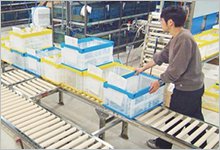
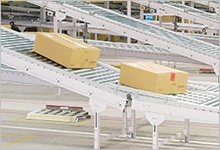
This is the lowest cost conveyor that does not require power.It can be used in a variety of ways depending on the application and working conditions, such as manual transport in horizontal installation or gravity transport in inclined installation.
- Horizontal hand-push transport
-
- Inclined gravity transport
-
② Wide variety
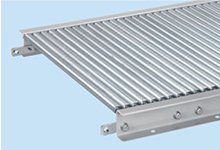
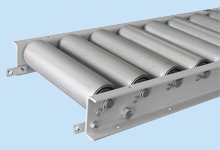
In addition to differences in materials such as iron, aluminum, stainless steel, and resin, the lineup includes 43 models, ranging from light load small items to extra heavy loads.With a wide range of options, you can choose the perfect model for a variety of transported items.
- ER for small, light loads
-
- NHR for extra heavy loads
-
3. RoHS2 compliant for environmental friendliness
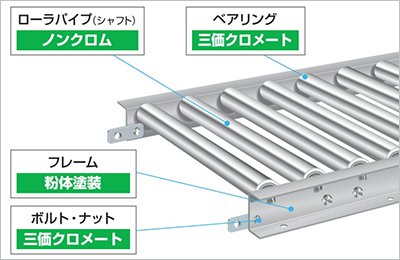
This conveyor is environmentally friendly, using materials that comply with the RoHS2 Directive, eliminating specific hazardous substances from the powder-coated frame, rollers, and bolts.
*Conveyors are exempt from RoHS2, but we are working to comply with RoHS2 in the event that they are used in conjunction with applicable products (electrical and electronic equipment) such as sensors.
[What is the RoHS2 Directive?]
The EU (European Union) Directive on the Restriction of the Use of Certain Hazardous Substances came into effect in July 2019. It prohibits the inclusion of certain hazardous substances in all electrical and electronic equipment, and the following 10 substances are subject to regulation.
- lead
- cadmium
- Hexavalent chromium
- mercury
- Polybrominated Biphenyls
- Polybrominated diphenyl ether
- Bis(2-ethylhexyl) phthalate
- Butyl benzyl phthalate
- Dibutyl phthalate
- Diisobutyl phthalate
Note: Parts other than the conveyor body, such as legs and guides, and specified colors are not supported, so please contact us if you require RoHS2 compliance.
About the selection
① Checking the transported items and working environment
When selecting Roller Conveyor, please first confirm the following prerequisite conditions in as much detail as possible.
① Conditions of transported goods
- External dimensions (length, width, height) and flow direction.
- Mass per unit (maximum and minimum if multiple types are used).
- The shape and material of the transported items, such as cardboard cases, plastic cases, wooden boxes, etc.
- Condition of the bottom (be careful of the bottom of cans and plastic cases)
② Conveyance amount conditions
- Are the items packed tightly together on the conveyor, or are they spaced apart at an appropriate distance?
③ Working conditions
- Either room temperature, high temperature, or low temperature.
- How much water and humidity is there?
④ Loading conditions
- How to load items onto the conveyor?
How to read the width of the transported item
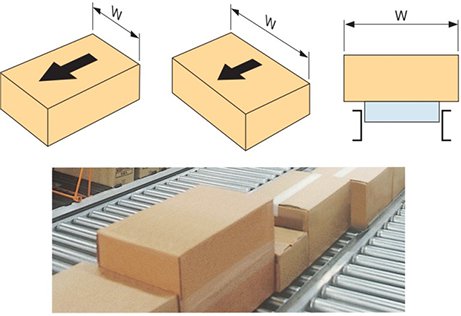
Even for the same transported item, the width dimension (W) will differ depending on the flow direction. When checking the transport direction, be sure to draw a simple diagram and clearly indicate the transport direction with an arrow.
② Roller width selection
First, select the roller width according to the external dimensions of the transported item.
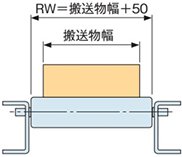
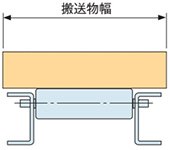
① Select the RW nominal roller width to be at least the width of the bottom of the transported item + 50 mm.
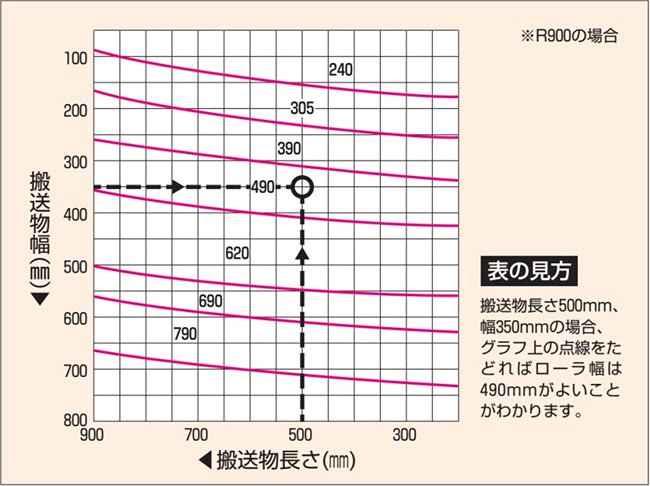
② If there is a curve, the roller width will vary depending on the width and length of the transported item. Refer to the table below to select the roller width.
③ Even if the width of the bottom of the transported item is wider than the roller width, it can be transported if the bottom is flat and not sagging (overhang transport). However, the bottom of the transported item must not come into contact with the conveyor frame. The roller width should be 70 to 80% of the width of the bottom of the transported item.
When transporting pallets, etc.
Considering the strength of pallets and the transportation of heavy items, we recommend using a double-row conveyor.

③ Model selection
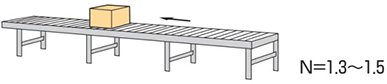
The impact load on the rollers varies depending on the loading conditions and work method.
Select a roller that can withstand impacts using the values below and the strength table for each roller.
Strength of one roller ≧ Maximum amount of material being conveyed × Impact factor (N)
Click here for the strength table per roller
In the case of a light impact
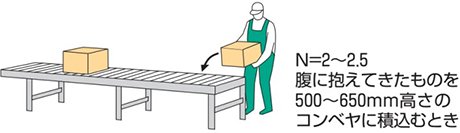
Transport only
④ Roller pitch selection
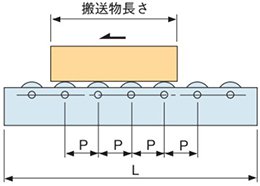
Always make sure that the bottom of the transported item is supported by at least three or four rollers. Also, make sure that the load received by each roller is below the allowable load.
⑤ Selecting the frame and leg mounting pitch
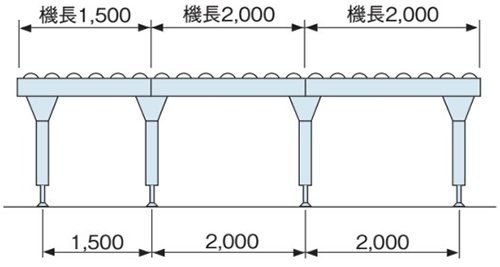
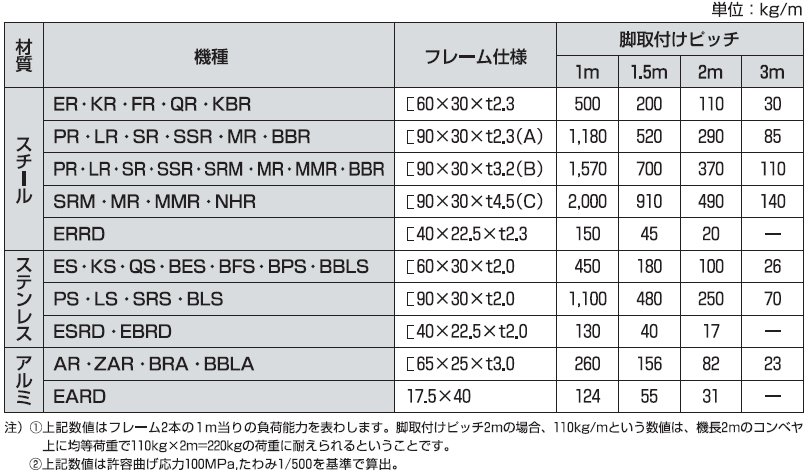
As a guideline, one leg should be installed every 1,500 to 2,000 mm on straight sections. As a guideline, one leg should be installed in the middle of curved sections with an angle of 45° or more. For details, refer to the "Strength table for two frames" below, convert the weight of the transported material into mass per 1 m, and select leg installation that is equal to or less than the allowable load.
Strength table for two frames
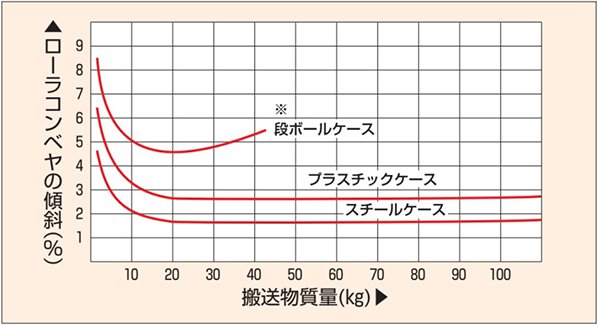
⑥ Guide to selecting the self-propelled gradient (incline angle)
The self-propelled gradient will vary depending on the condition of the bottom surface of the transported object, the material, and the weight, but please refer to the table below as a rough guide.
*If the bottom surface is made of a soft material such as cardboard, a large amount of material will get stuck in the rollers, causing increased resistance.
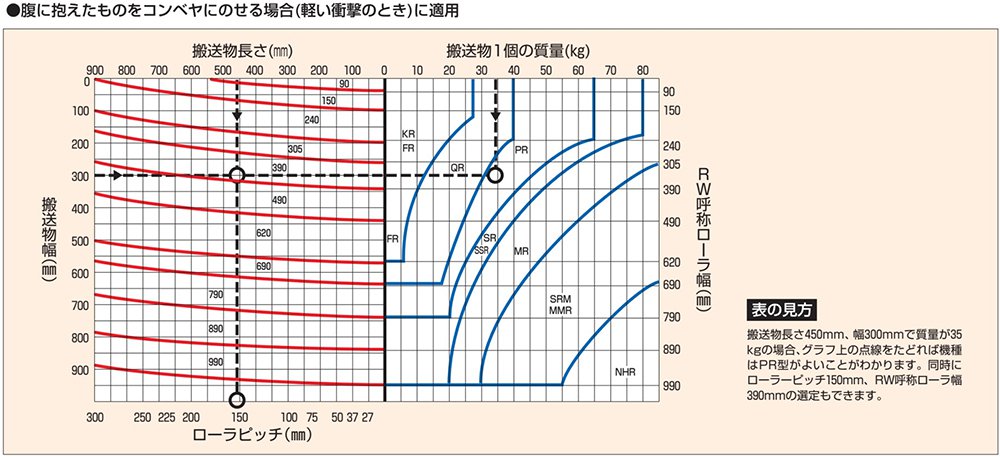
Quick guide to selecting a model based on the dimensions and mass of the transported items
Common Specifications
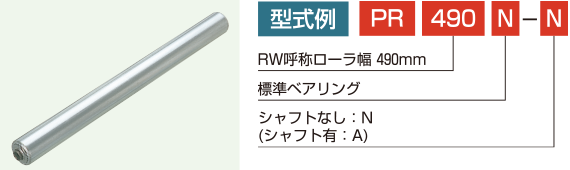
Roller only
The PS, LS, SRS, and NTS types use greased bearings that are also used for the drive, so rotational resistance is somewhat greater.
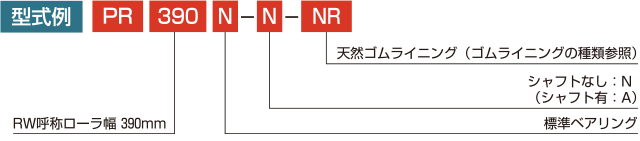
Rubber lining specifications
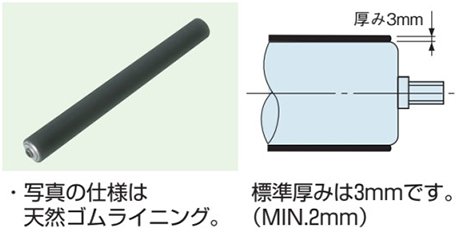
| Lining type | Lining type | Points to note |
|---|---|---|
| Natural Rubber NR | General use | Weak to oil |
| Urethane rubber UR | Abrasion resistance | Heat-sensitive |
| Nitrile rubber NB | Oil resistance | benzene· Weak against toluene |
| Neoprene Rubber CR | Heat and chemical resistance | In ethyl acetate weak |
・Please contact us for lining specifications other than those listed above.
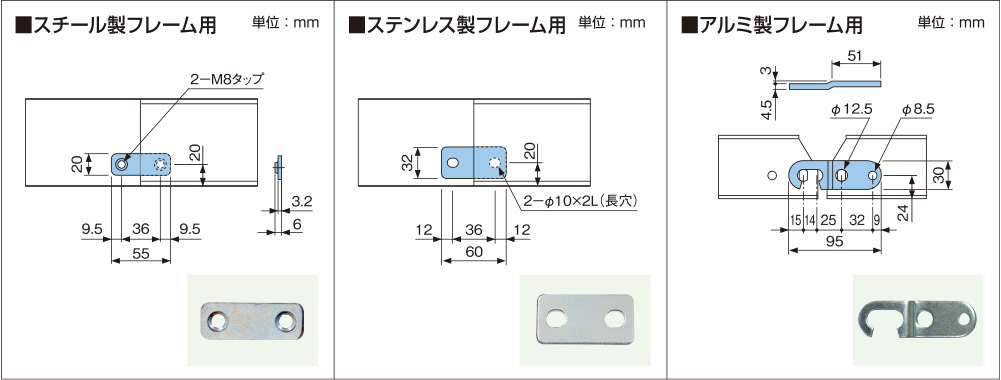
Connecting fittings
Paint color
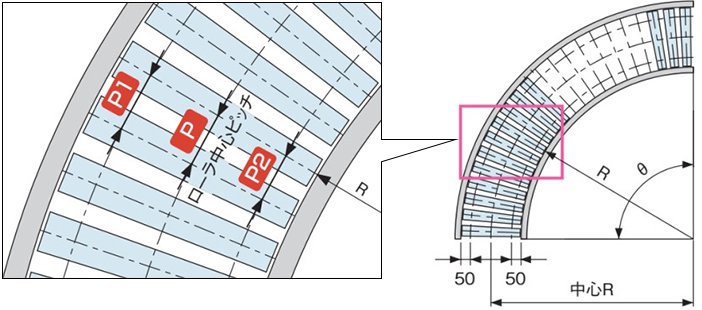
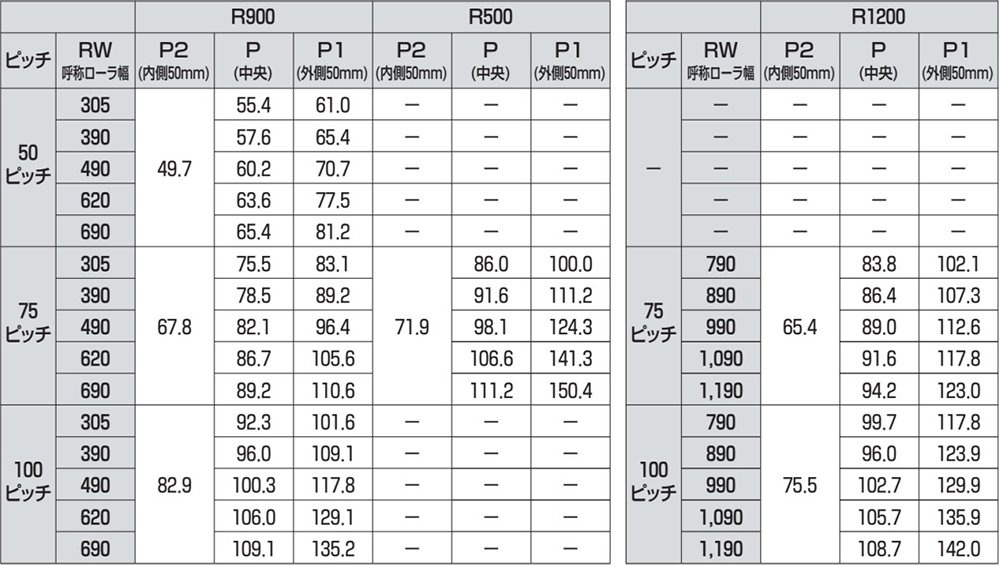
Roller pitch of curved Roller Conveyor
Application example
- Dried Persimmon Factory
-
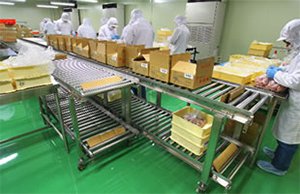
A two-stage stainless steel conveyor installed in the boxing process
- printing factory
-
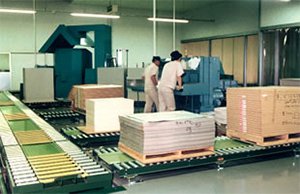
Roller Conveyor used for transporting paper pallets.
- Peach sorting facility
-
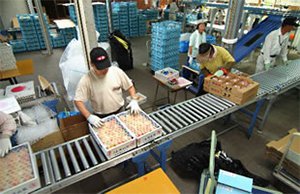
Aluminum conveyor introduced in the shipping process
- Tropical fish distribution center
-
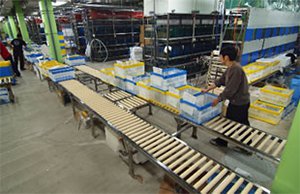
Stainless steel conveyors laid out on the picking line
- Strawberry sorting facility
-
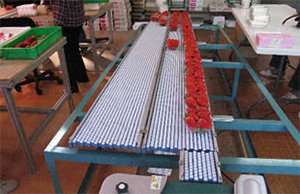
Corocon Mini introduced to strawberry storage line
- Home appliance distribution center
-
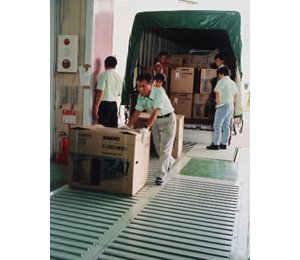
Roller Conveyor installed on the receiving line